

The Eisenhower Tunnel: The Hole in the Mountain That Built Colorado Ski Country
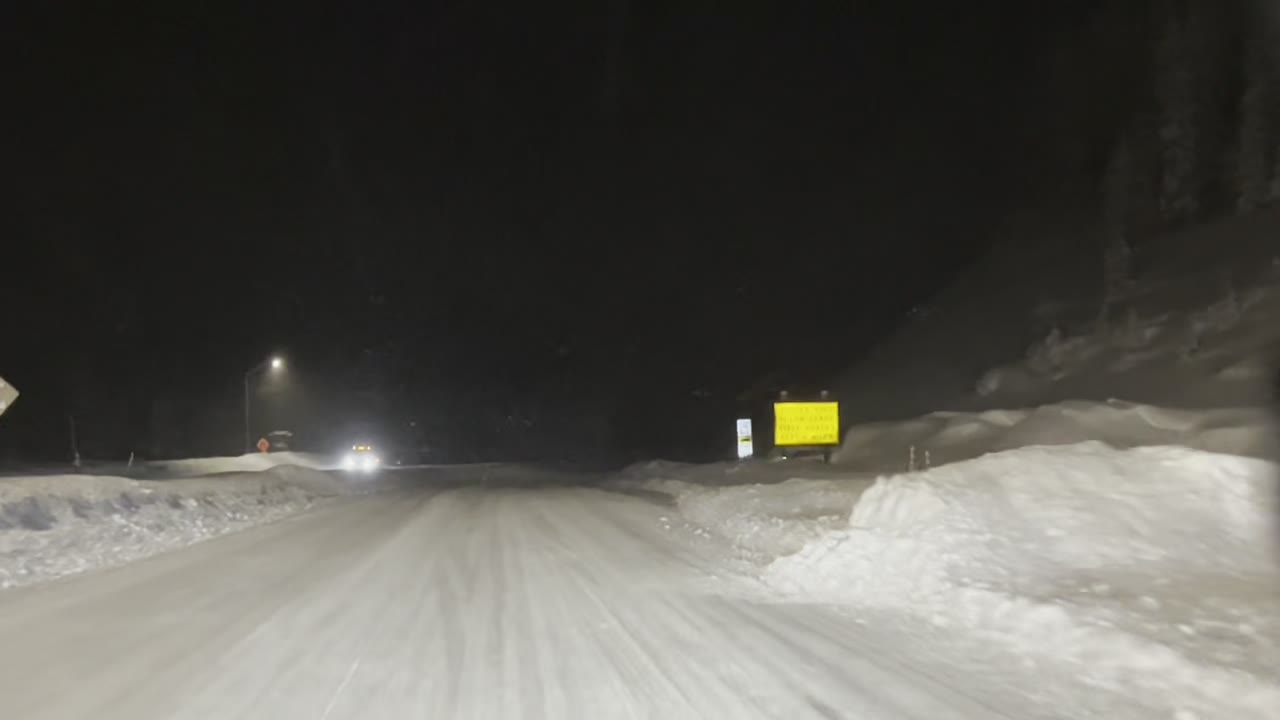
If you fly into Denver International Airport in winter and ride west with us, there is a moment about an hour into the trip when the highway simply disappears into the side of a mountain. One minute you’re climbing through Clear Creek County under open sky; the next you’re in a river of light and tile, 1,500 feet of rock over your head, crossing the Continental Divide inside the mountain instead of over it. Then — on a night like the one in the video above — you burst out the far side into falling snow, and the big overhead signs start talking to you: STEEP ICY ROAD. SLOW DOWN. Welcome to the west side of the Divide.
That hole in the mountain is the Eisenhower–Johnson Memorial Tunnel, and it’s hard to overstate what it means to Colorado. We drive it constantly — our home base in Empire sits just down the canyon from the east portal — and we never get tired of what it represents: before this tunnel, Colorado ski country was a hard place to reach. After it, the whole world could get there.
Before the Tunnel: The Loveland Pass Ordeal
Every trip from Denver to Summit County and Vail used to go over Loveland Pass on U.S. Highway 6 — a wagon road built in 1879 that wasn’t paved until 1950. The summit sits at 11,992 feet, more than 800 feet higher than the tunnel roadway, on a ribbon of hairpin switchbacks exposed to every storm that rolls down the Divide. In good weather it was slow. In bad weather it was worse: the pass closed for storms and avalanche danger, and a trip that looks like a couple of hours on a modern map could eat the better part of a day — or not happen at all.
The ski areas on the other side felt every mile of it. Loveland Ski Area opened in the 1930s right at the pass, Arapahoe Basin followed in 1946, and Breckenridge (1961) and Vail (1962) bet their futures on skiers being willing to make that climb. Those pioneers were right about the snow. The question was whether the road would ever let the rest of the world reach it reliably. Colorado argued about a tunnel under the Divide for decades — highway engineers first tried a small pilot bore near Loveland Pass in the early 1940s and abandoned it — before the 1956 Interstate Highway Act finally put federal money behind the idea.
Building It: Five Years Through the Divide
Engineers settled on the Straight Creek route, just south of Loveland Pass, and a pilot bore was holed through in 1964 to test the rock. Construction on the first big bore began March 15, 1968. The rock fought back — fractured, water-bearing, and squeezed under enormous pressure — and a job expected to take three years took five. Seven workers lost their lives building the two tunnels.
The westbound bore opened March 8, 1973. Built as the Straight Creek Tunnel, it was renamed before its dedication for President Dwight D. Eisenhower, father of the Interstate system. The numbers still impress: 1.693 miles long, climbing at a 1.64% grade from 11,013 feet at the east portal to 11,158 feet at the west — the highest point on the entire U.S. Interstate Highway System, and its longest mountain tunnel. The final cost was $108 million, more than double the original estimate, about 90% of it federal money. For its first six years that single bore carried traffic in both directions.
The eastbound twin, named for Edwin C. Johnson — the Colorado governor and U.S. senator who had championed an interstate across Colorado — opened December 21, 1979. At 1.697 miles, it completed one of the last major pieces of the Interstate system.
What It Changed: Ski Country Opens Up
The tunnel cut 9.1 miles of winding pass road out of the trip, but the real change wasn’t mileage — it was reliability. A four-lane, all-weather route under the Divide, kept open around the clock by its own dedicated crews, turned a weather gamble into a schedule. The timing tells the story: Keystone opened in November 1970 and Copper Mountain in December 1972, just as I-70 and the tunnel were arriving, joining Loveland, A-Basin, Breckenridge and Vail along one corridor. Beaver Creek followed in 1980. Denver International Airport eventually put that corridor within a flight of everywhere, and Colorado skiing became a global industry — one widely cited industry study credits skiing with about $4.8 billion a year in economic impact for Colorado and roughly 46,000 jobs, much of it flowing through this 1.7-mile hole in the rock. More than 434 million vehicles had passed through the tunnels by early 2023 — on the order of 35,000 on an average day, and far more on a powder weekend.
The Tunnel Today: Still a Serious Winter Drive
None of that made the drive easy — just possible. The tunnel sits in a zone that averages 315 inches of snow a season. Its approaches are steep — about 6% on the east side, 7% on the west — which is why the signs in the video are lit. On the descent, trucks are held to low gears, traffic is sometimes metered or held for safety, and when storms or crashes close the bores, there is no quick way around. Loveland Pass still does its old job in one respect: trucks hauling hazardous materials are banned from the tunnel and must climb the pass in all weather — and when the pass itself closes, those trucks are escorted through the tunnel in convoys once an hour while regular traffic waits, about 15 minutes at a time.
This is the part visitors underestimate. The flight into DEN is the easy leg. The last stretch — out of the tunnel, down an icy 6% grade at 11,000 feet, in the dark, in a storm — is where local knowledge earns its keep: knowing when to leave, when to wait out a closure, and how the corridor behaves when the snow starts stacking up.
Ride It With People Who Drive It Every Week
At Great Divide Transportation, this tunnel is our commute — the gateway on nearly every airport run we make from DEN to Vail, Beaver Creek, Breckenridge, Keystone and Winter Park, and the landmark our Clear Creek County neighbors live beneath. If you’d rather watch the Divide roll over your head from a warm back seat than white-knuckle it yourself, call us at (970) 763-8169 and we’ll handle the mountain for you.